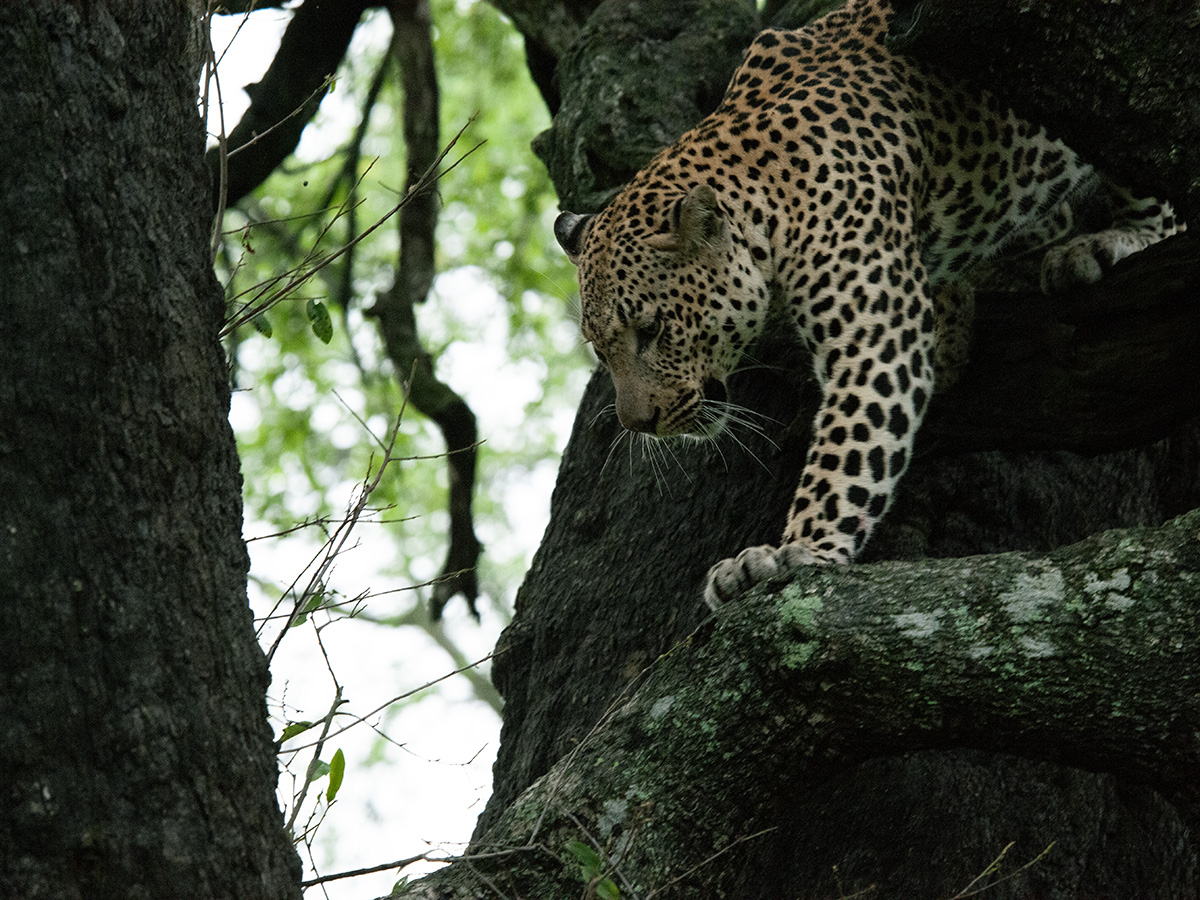
Leopards are considered to be solitary animals, but they only are to some extend. On private game reserves where leopards have been observed for decades, interesting interactions have been witnessed. Male leopard territories overlap the territories of several females, how many females depends on the size of the male’s territory, which depends on his strength of keeping other males away. The females in a male’s territory are mostly not related. Usually an adult cub moves away to establish a territory elsewhere. However, some females stay in the area and some take over part of their mother’s territory. This specific leopard family situation was unusual. The mother and daughter had neighbouring territories, partially overlapping. They had decided that the mother would look after one of the daughter’s two cubs, which would increase the chances of survival for both cubs. The daughter supported her mother in the care of the cub with food. The male leopard and father of the cubs met with them regularly, sometimes all of them were in the same tree. When the male cub raised by the grandmother became an adult, he was not forced out of his father’s territory, as it would normally be the case. His father allowed him to stay, possibly to help control it. It could also have played a role that the grandmother was at that time very old and they might have anticipated on her passing and a reshuffle of territories. Either way, what this example shows is that leopards interact more with each other than often thought. In some areas these usually illusive animals can be observed more closely and more can be understood about their social behaviour.